Skip to content
  • Home
  • Pricing
  • Support
  • Download
  • My account
auto rigger
  • Home
  • Pricing
  • Support
    • Documentation
    • Tutorials
    • Create A Ticket
    • Contact Us
    • Changelog
  • Download
MY ACCOUNT
auto rigger

Setup Arise

6
  • Introduction
  • System Requirements
  • Create Account / Login
  • Installation
  • License Activation Instructions
  • Troubleshooting

Getting Started Tutorial

8
  • Interfaces (UI)
  • How To Prepare The Model For Rigging?
  • What Are Nodes, Attachments, and Presets?
  • What Are Guides?
  • What is The Attribute Editor?
  • Let’s Start Rigging
  • How To Export Rigs?
  • Digging Deeper

Elements

29
  • Node
  • Attachment
  • Presets
  • Attribute Editor And Attributes Types
  • Workspace
  • Outliner
  • Guides
  • Connections
  • Loading/Saving
  • Placeholders
  • Dump_grp
  • Skinning Joints
  • Poses
  • Group Node
  • Rig Base Node
  • Helper Tools
  • Preferences
  • Scene Settings
  • Log Viewer
  • Model Validation Checks
  • Model Updater
  • AI Auto Guides Placement
  • Rig Mocap Tester
  • Rig Export
  • Batch Menu
  • Sticky Note
  • API Commands
  • Custom Ctrls Shapes
  • Ctrl Shapes Lookup

How To Create Your Own Node

6
  • The Basics On How To Create Your Own Node
  • Creating Attributes
  • Creating Guides
  • IoJoint
  • IoTransform
  • Example Node Module

How To Create Your Own Attachment

1
  • Creating Custom Attachments in Arise

Basic Nodes

8
  • Base Node
  • One Joint
  • FK Chain
  • IK Chain
  • Two Joints IK
  • Dynamic FK Chain
  • Eye
  • Path

CA Nodes

12
  • CA_Spine
  • CA Head
  • CA Leg
  • CA Arm
  • CA Fingers
  • CA_Mouth
  • CA Eye
  • CA Quadruped Back Leg
  • CA Quadruped Front Leg
  • CA Ribbon
  • CA Tentacle
  • CA Wing

Attachments

22
  • SpaceSwitch
  • CtrlsShape
  • CtrlsSettings
  • MakeDynamic
  • FollowSkeleton
  • PostScript
  • MovablePivot
  • HelperJoints
  • Rename
  • AttributesSettings
  • CustomDriver
  • CustomDriven
  • ManualConnections
  • AddJoints
  • AddGroupAbove
  • JointsSettings
  • Parent
  • AddAttribute
  • ConnnectAttribute
  • HumanIK
  • CtrlsLockHideAttributes
  • CtrlsLimitAttributes

Mechanical

2
  • Vehicle Body
  • Wheel
View Categories
  • Home
  • Arise Docs
  • Elements
  • Attribute Editor And Attributes Types

Attribute Editor And Attributes Types

When a node is selected, its attributes and its attachments attributes will appear in the ARISE Attribute Editor (Not to be confused with Maya’s Attribute Editor).

A tooltip will appear when you hover over an attribute value. They help you understand what each attribute does.

If you right-click on the attribute name, a context menu will open with different options depending on the attribute type and state.

  • ‘Reset To Default Value’ – All attributes will have this option.
  • ‘Break Incoming Connection’ – Only on Driven Connection attributes.
  • ‘Demote/Promote Attribute’ – Some attributes can be promoted, which means they will be displayed on the node shape allowing for connections to be made.

Docs:

You will find the docs tab next to the attribute editor tab; in it, you will find tabs for the node and each of its attachments so you can better understand their functions.

Lock:

To lock the Attribute Editor to display only one node, toggle the lock icon at the top left of the attributes window. 
Toggling again will unlock it.

Collapse/Expand All Sections:

Two buttons to either collapse or expand all the collapsible 

Attributes:
You can auto scroll to a node or an attachment attributes by hold Shift + Ctrl and middle mouse click on the node or attachment shape.
There are many kinds of attributes: Checkbox, Button, Dropdown, Float, Integer, Name/String, RGB, XYZ, Radio, and Path.
Additionally, there are a number of unique attributes:

Title Attribute:
Below the lock button, the ‘Title’ attribute will display the node’s icon, the node’s name, the node type/module, as well as two buttons for expanding or collapsing all expandable sections.

Name Attribute:
The name of a node is used to name its Maya objects when the node is built.
Node names must start with a letter and consist of 3-25 characters of numbers, letters, and ‘_’.

Module Version Attribute:
A node can have different versions in order to support changes/fixes/enhancements to the code while still supporting backward compatibility.
An old rig created with an old version of a node will continue to use the old version, while a newly created rig will use the latest version.
While you can always manually change versions, note that some data can be lost when switching versions.
This attribute should not be touched if you are unsure how to use it.

Driven Connection Attribute: 
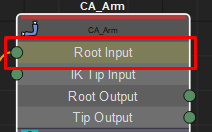
The ‘Driven Connection’ Attribute enables you to constrain different elements of the rig to each other. This attribute is displayed in both the Arise Attribute Editor and on the node shape if it has been promoted.

To connect the ‘Driven Connection‘ Attribute to another node’s ‘Driver Connection‘ attribute, simply make a connection between them. If the connection is successful, the attribute will turn yellow. 

Alternatively, you can also enter a string Maya transform name directly into the attribute field. This provides you with the ability to connect any Maya transform node as the driver.
When entering a string transform name, the indicator (*) on the right side of the attribute field will indicate whether the input is valid. If you hover over the indicator, you can view additional information. In the event that the entered transform name is invalid, an error will also be displayed in the Log Viewer during the build process.

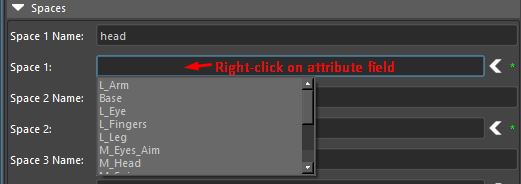
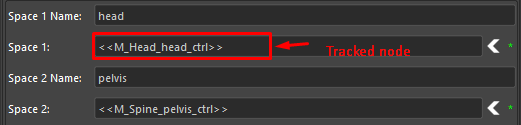
In version 1.02.00, ‘Tracked nodes’ were introduced, which you can select by right-clicking the attribute field and choosing a node. Once selected, you can choose any of its ctrls or joints as the driver for this attribute.
Tracked ctrls or joints do not require updating if the node they are attached to is renamed, as they are linked by a unique identifier, unlike string inputs that rely on the node’s name and need updating if it changes.
Driver Connection Attribute:
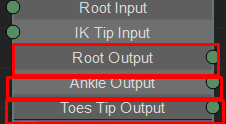
This attribute appears only on the node shape as an attribute with a green circle to its right.
Only this attribute can drive a ‘Driven Connection’ attribute.

Custom Driven Connection Attribute / Custom Driver Connection Attribute:

They are different from the standard ‘Driven/Driver Connection’ attributes since they do not constrain between transforms. Instead, they allow any kind of connection to be made.

Table Attribute:
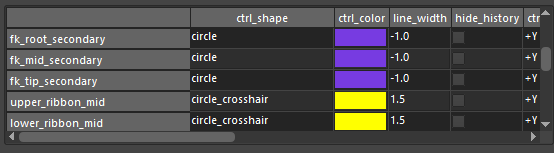
Since Attachments can modify ctrls and joints, the Table attribute provides a dynamic and easy-to-edit view of all the ctrls or joints of the node.
Colors, Dropdowns, Integers, Floats, text, and Checkboxes can be displayed in the table attribute.
Values that have been modified will appear in a red box.
To remove modifications from a specific cell, right-click on a cell that appears red.
You can right-click on its name in the vertical header, to select the ctrl or joint in the Maya scene.

Note Attribute:
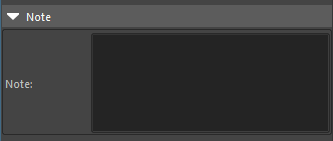
You can use this attribute to leave a note to yourself or others about what you did differently.
This helps others understand how the character was rigged.
It appears at the bottom of all nodes and attachments.

_____________________________________________
Get Arise at: https://www.ariserigging.com
Follow on LinkedIn 

Updated on May 13, 2026

What are your Feelings

Share This Article :

  • Facebook
  • X
  • LinkedIn
  • Pinterest
PresetsWorkspace
  • Home
  • Pricing
  • Support
  • My account
  • Privacy Policy
  • EULA

Copyright © 2026 - Arise Rigging System

This website uses cookies to ensure you get the best experience. By using this site, you agree to our use of cookies.
Accept
Manage consent

Privacy Overview

This website uses cookies to improve your experience while you navigate through the website. Out of these, the cookies that are categorized as necessary are stored on your browser as they are essential for the working of basic functionalities of the website. We also use third-party cookies that help us analyze and understand how you use this website. These cookies will be stored in your browser only with your consent. You also have the option to opt-out of these cookies. But opting out of some of these cookies may affect your browsing experience.
Necessary
Always Enabled
Necessary cookies are absolutely essential for the website to function properly. These cookies ensure basic functionalities and security features of the website, anonymously.
CookieDurationDescription
cookielawinfo-checkbox-analytics11 monthsThis cookie is set by GDPR Cookie Consent plugin. The cookie is used to store the user consent for the cookies in the category "Analytics".
cookielawinfo-checkbox-functional11 monthsThe cookie is set by GDPR cookie consent to record the user consent for the cookies in the category "Functional".
cookielawinfo-checkbox-necessary11 monthsThis cookie is set by GDPR Cookie Consent plugin. The cookies is used to store the user consent for the cookies in the category "Necessary".
cookielawinfo-checkbox-others11 monthsThis cookie is set by GDPR Cookie Consent plugin. The cookie is used to store the user consent for the cookies in the category "Other.
cookielawinfo-checkbox-performance11 monthsThis cookie is set by GDPR Cookie Consent plugin. The cookie is used to store the user consent for the cookies in the category "Performance".
viewed_cookie_policy11 monthsThe cookie is set by the GDPR Cookie Consent plugin and is used to store whether or not user has consented to the use of cookies. It does not store any personal data.
Functional
Functional cookies help to perform certain functionalities like sharing the content of the website on social media platforms, collect feedbacks, and other third-party features.
Performance
Performance cookies are used to understand and analyze the key performance indexes of the website which helps in delivering a better user experience for the visitors.
Analytics
Analytical cookies are used to understand how visitors interact with the website. These cookies help provide information on metrics the number of visitors, bounce rate, traffic source, etc.
Advertisement
Advertisement cookies are used to provide visitors with relevant ads and marketing campaigns. These cookies track visitors across websites and collect information to provide customized ads.
Others
Other uncategorized cookies are those that are being analyzed and have not been classified into a category as yet.
SAVE & ACCEPT